


The Aesthetic Realism Foundation is very grateful for the support received from those who attended our Holiday Gala Benefit.
It was a great success! The funds raised are essential for the many courses and classes taught here and for the outreach workshops and events the Aesthetic Realism Foundation provides throughout the metropolitan area and beyond.
To learn more about our educational programs—click here.
Aesthetic Realism Consultations: In consultations, a person’s individual life questions are understood and explained, through the principles of Aesthetic Realism....more
Read an important letter by sculptor Donita Ellison!It's about the Aesthetic Realism Foundation and why its work is so valuable. She says (for instance):
“How do we see people other than ourselves? is the biggest matter in everyone’s personal life. It’s also the biggest matter in America’s economy, and in what happens in our streets, schools, government. And it’s through Aesthetic Realism consultations that a person can make sense at last of how he or she sees other people—and change magnificently for the better!...”Read more
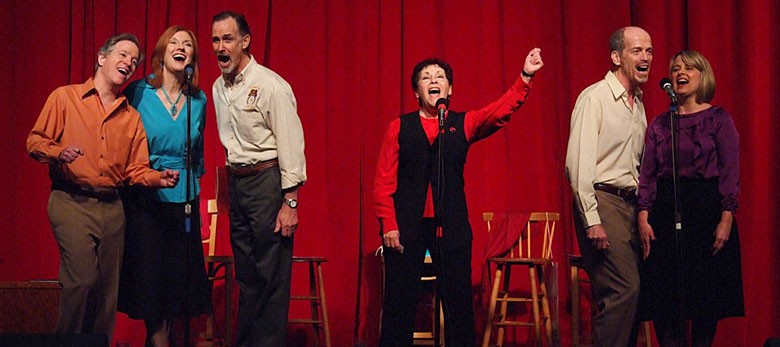
Pioneering dramatic and musical presentations take place at the Foundation, and elsewhere as part of the Foundation’s Outreach Program. These productions—a new dramatic form with performance and comment—include “Shakespeare’s A Midsummer Night’s Dream; or, Earthy Whirl,” by Eli Siegel; “Rock ‘n’ Roll, the Opposites, & Our Greatest Hopes!”; “Ibsen, Bach, & What Interferes with Love”‘ and more.
Sunday, June 23, 2:30 PM
The Aesthetic Realism Theatre Company presents—
Evil Seen Beautifully! or,
Voltaire's Candide
A dramatic production of Eli Siegel's great 1951 lecture
There's nothing people need more at this time than an accurate, courageous, lively, and beautiful way to see the relation of good and evil! That's what this presentation is about—and has.
In 1951 Eli Siegel, founder of Aesthetic Realism, lectured on Voltaire's very funny 1759 novel. He said:
"Candide, though written in the middle of the polite 18th century, is one of the giddiest, speediest works that ever lived. And its beauty is its speed. It is a poetic, musical composition, with evil presented clearly in a tireless sort of dance."
Here is the 2nd section of the 1964 lecture Aesthetic Realism Looks at Feeling, by Eli Siegel. In it he defines feeling in a way that I think is great. The definition gets to what every feeling is—from the most intense to the most tepid; from the feelings we’re proudest of to those that make us ashamed; from those we’re keenly aware of to those that subtly and intricately mingle with other feelings, so that we don’t know what they are. He defines feeling as “any instance whatever of pain or pleasure.” And he says, “A feeling is always a for and an against.”
One can see, in this 2nd section, that Eli Siegel’s spoken prose is beautiful. And through it, one has a sense of who he was—of his own feeling and knowledge. In all his lectures, Mr. Siegel spoke without notes, and here one can see in the sentences the inseparability of scholarship and pleasure which stood for him so much. He is humorous, playful, yet utterly serious and exact. I love, more than I can express, his remarkable and so respectful ease amid, and delight in, the literature of the centuries.
I’ll comment a little on some of the matters he speaks about. First: that terrific feeling which is anger. Today people are as worried as ever about their anger, and “anger management” instruction is an industry—a largely unsuccessful one. Aesthetic Realism makes clear what nothing else does: that there are two kinds of anger—one good, one bad... more
On the first Thursday of every month the Aesthetic Realism Consultants and Associates present public seminars. Representative subjects include: “Real Communication in Marriage—How Can We Have It?”; “What's the Difference between Wowing People & Liking Yourself?”; “Kindness: Is It Strong ?”; “The Aesthetic Realism Teaching Method Succeeds: Knowledge Wins, Prejudice Loses!”
Thursday, July 11*, 6:30 PM
The Confusion in Men about Coolness & Warmth
Come learn about yourself & everyone at this great seminar!
How much should we care for the world and people? Should reality stir us, or should we be cool to it, aloof from it? The speakers, consultants Arnold Perey, Joseph Meglino, and Ken Kimmelman, will answer these questions--and they'll show how Aesthetic Realism enables men at last to make sense of the confusion about coolness and warmth!
The consultants will describe what they learned about their own lives as to this crucial subject, including in classes taught by Eli Siegel. They'll look too at the lives of men in literature and film. And you'll hear about the vital, kind education that contemporary men are receiving in Aesthetic Realism consultations: education making it possible for them to care honestly and accurately for the world and people--including women.
This is an event not to be missed!
*Please note: Seminar date has been changed due to the Independence Day holiday.
Saturday evening public presentations feature dramatic readings of some of the lectures on literature, ethics, history, and art given by Eli Siegel, and talks by artists and scholars on this new way of seeing all the arts and sciences.
Saturday, July 20, 8PM
Humor—Its Meaning for Our Lives!
Humor & Strangeness
In this very funny and greatly cultural talk, Eli Siegel discussed the famous “Rumpelstiltskin” story; Don Marquis’ archy and mehitabel, a tale about an intellectual cockroach and his feline friend; & Milt Gross’s delightful Nize Baby:
“Humor does something to reality—it’s a mingling of the
world gone crazy and the world gone ever so correct….
Art can be called ‘the satisfying wildness.’”
How Much Should I Care for Things? Aesthetic Realism Lesson
“Do you think it is wise to care for things? It
does take away time from yourself, you know.”—Eli Siegel
The Mad Logic of the Marx Brothers By filmmaker and animator Ken Kimmelman
“The Marx Brothers put together opposites every person
wants to do a good job with: wildness and accuracy,
surprise and symmetry, freedom and order, the zany
and sane—all with a speed and precision which have
made people around the world laugh uproariously….
The way Groucho could poke fun at people in high
places who were pretentious and snobbish was hilarious
and useful.”