

ELI SIEGEL, FOUNDER OF AESTHETIC REALISM
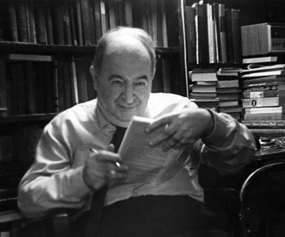
Mr. Siegel in his library signing his book of poems
Hail, American Development. Photo by Nancy Starrels
ELI SIEGEL (1902-1978), poet, critic, philosopher, educator, and founder of Aesthetic Realism was born on August 16, 1902, and grew up in Baltimore. In August 2002, on his centenary, Baltimore celebrated Eli Siegel Day with proclamations by the mayor and governor, and a memorial to him was erected in Druid Hill Park.
Several of Eli Siegel’s earliest essays were published in the Modern Quarterly magazine, which he founded with V.F. Calverton in 1923. The essays, including “The Scientific Criticism,” “The Equality of Man,” and “The Middle Ages, Say,” are now collected in The Modern Quarterly Beginnings of Aesthetic Realism.
Nation Poetry Prize
In 1925, at age 22, Eli Siegel won the esteemed Nation magazine poetry prize for his poem “Hot Afternoons Have Been in Montana.” Years later, describing the significance of “Hot Afternoons,” poet William Carlos Williams wrote: “I say definitely that that single poem, out of a thousand others written in the past quarter century, secures our place in the cultural world.” Implicit in the poem, Mr. Siegel later explained, were the philosophic principles that would become the basis of Aesthetic Realism. In the same year, 1925, Mr. Siegel became a columnist for the Baltimore American.
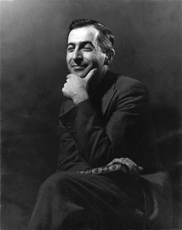
Chairing innovative evenings of poetry & jazz at the Village Vanguard
Donald Kirkley, who knew Mr. Siegel in the 1920s, recounted in a 1944 article in the Baltimore Sun:
Baltimore friends close to him at the time [he won the Nation prize] will testify to a certain integrity and steadfastness of purpose which distinguished Mr. Siegel….He refused to exploit a flood of publicity which was enough to float any man to financial comfort…. He took a job as a newspaper columnist at a respectable salary, and quit it when he found that he would not be allowed to say what he wanted at all times.
In 1926, Mr. Siegel settled permanently in New York City. He became a reviewer for the New York Evening Post Literary Review and Scribner’s Magazine, writing about works such as Edmund Kean by Harold Newcomb Hillebrand, The Life of Emerson by Van Wyck Brooks, and Mark Twain’s America by Bernard DeVoto. In the 1930s, Eli Siegel chaired poetry events at the Village Vanguard, the famed Greenwich Village nightspot.
Poetry Classes & Aesthetic Realism
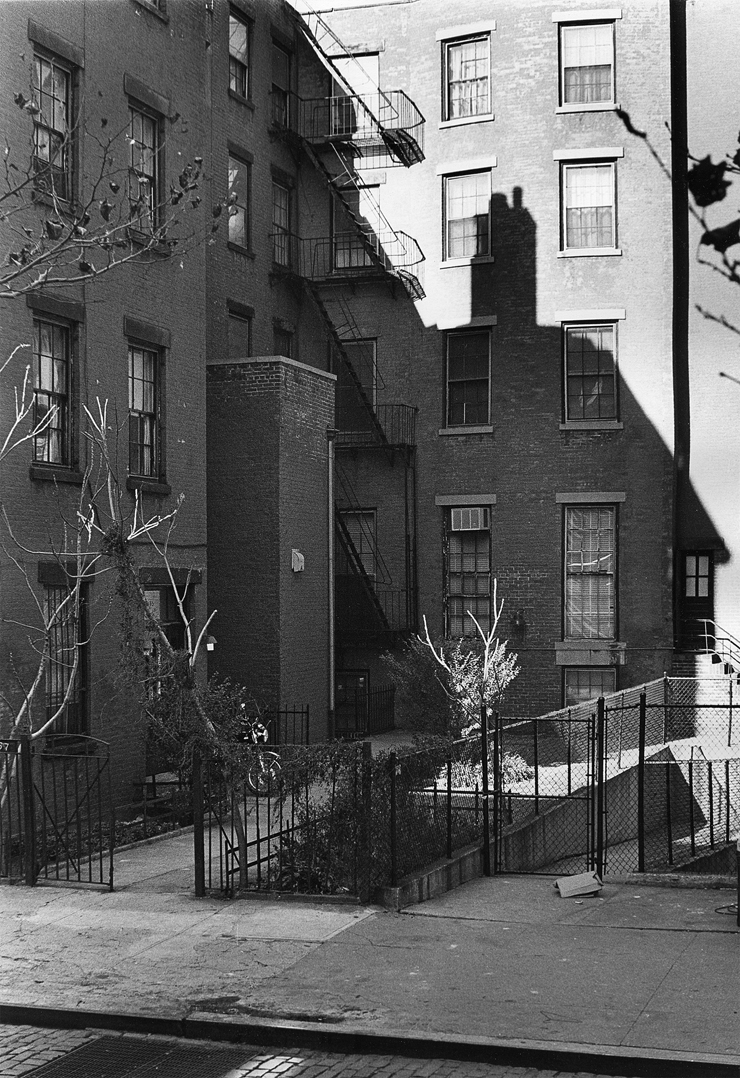
67 Jane Street, NYC.
Photo by Nancy Starrels
In 1938, Mr. Siegel began teaching The Poetry Group, which was attended by New York City writers and artists. At the same time, he was developing the philosophy that, in 1941, became Aesthetic Realism.
Beginning that year and for nearly four decades, in his library at 67 Jane Street, Mr. Siegel gave thousands of lectures—on literature, poetry, history, economics, the human mind, the arts and sciences—and individual lessons to men, women, and children.
These lectures and lessons taught a new way of seeing the world and other people based on the following principles:
- The deepest desire of every person is to like the world on an honest or accurate basis.
- The greatest danger for a person is to have contempt for the world and what is in it….Contempt can be defined as the lessening of what is different from oneself as a means of self-increase as one sees it.
- All beauty is a making one of opposites, and the making one of opposites is what we are going after in ourselves.
In 1944, Mr. Siegel married Martha Baird, poet and writer on music.
Letter of William Carlos Williams
The historic letter from poet William Carlos Williams to Ms. Baird, November 1951, places authoritatively the importance of Eli Siegel’s poetry in American literature and also describes the injustice Mr. Siegel met. Williams wrote about “Hot Afternoons” and other poems by Eli Siegel:
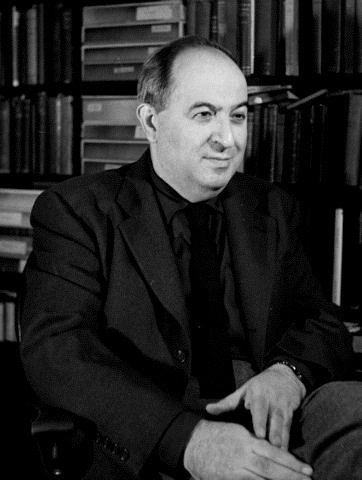
Eli Siegel in the 1950s.
Photo by Morris Jaffe
“We are compelled to pursue his lead. Everything we most are compelled to do is in that one poem.
“…As I read his pieces I am never prepared for what will come next, either the timing or the imagery….This is powerful evidence of a new track….The evidence is technical but it comes out at the non-technical level as either great pleasure to the beholder, a deeper taking of the breath, a feeling of cleanliness, which is the sign of the truly new. The other side of the picture is the extreme resentment that a fixed, sclerotic mind feels confronting this new. It shows itself by the violent opposition Siegel received from the ‘authorities’ whom I shall not dignify by naming.”
You can read Williams’ entire letter to Martha Baird. In addition, Mr. Siegel’s 1952 lecture on the poetry of Williams, at which Williams was present, is in The Williams-Siegel Documentary.
In 1955, artists and writers opened the Terrain Gallery with this statement by Eli Siegel as its basis: “In reality opposites are one; art shows this.” That same year, the Terrain Gallery published the broadside “Is Beauty the Making One of Opposites?”—15 questions by Mr. Siegel that define beauty in the visual arts. The Terrain began holding exhibitions, lectures, poetry readings, and art talks presenting this new relation of the world, art, and life.
Mr. Siegel’s first book of poems, Hot Afternoons Have Been in Montana: Poems was published in 1957. It was nominated for the National Book Award, and in 1958 he was nominated for the Pulitzer Prize in Poetry. Hail, American Development, his second volume of poems, which includes 32 translations, was published in 1968. Both volumes were highly acclaimed, including in the Saturday Review, the New Mexico Quarterly, and the New York Times Book Review.
The Aesthetic Realism Foundation, a not-for-profit educational foundation, was established in 1973 to teach Aesthetic Realism and have it known, with a distinguished faculty of consultants and associates.
On November 8, 1978, Eli Siegel died as the result of an operation performed on him in May of that year. You may read about this in the issue of The Right of Aesthetic Realism to Be Known titled “Always: Love of Reality.”
Congressional Tribute
Maryland Congressman Elijah E. Cummings, formerly Chair of the Congressional Black Caucus, stated in his congressional tribute to Mr. Siegel:
Eli Siegel died in 1978, but his poetry and the education of Aesthetic Realism will be studied in every English, literature, and art classroom across the nation for years to come.
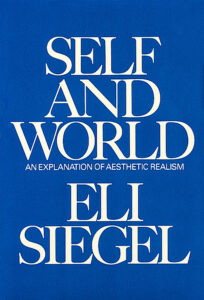 Mr. Siegel’s published works include Self and World: An Explanation of Aesthetic Realism (1981); James and the Children: A Consideration of Henry James’s “The Turn of the Screw” (1968); and Children’s Guide to Parents & Other Matters (1971, 2003). You can find out more about these and other books.
Numerous of his lectures, essays, and poems are published in the periodical The Right of Aesthetic Realism to Be Known, edited by the Aesthetic Realism Chair of Education, Ellen Reiss. They are also available in the Aesthetic Realism Online Library. To-be-published works include The Aesthetic Nature of the World; a third volume of poetry, Dear Time; Shakespeare’s Hamlet: Revisited; and hundreds of additional poems, lectures, and essays.
In 2005, Emmy Award-winning filmmaker Ken Kimmelman produced a film of “Hot Afternoons Have Been in Montana” based on a recording of Eli Siegel reading the poem. The following lines from “Hot Afternoons” stand for that way of seeing that is central to Aesthetic Realism, and that Eli Siegel himself always had:
The world is waiting to be known; Earth, what it has in it! The past is in it;
All words, feelings, movements, words, bodies, clothes, girls, trees, stones, things of beauty, books, desires are in it; and all are to be known;
Afternoons have to do with the whole world;
And the beauty of mind, feeling knowingly the world!
* * *